
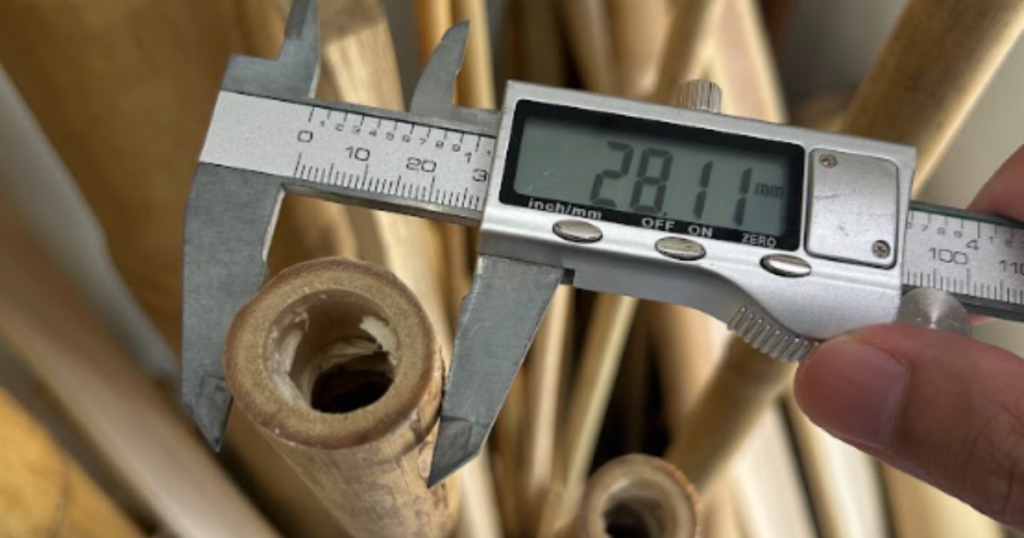
The question arrives in almost every project enquiry, usually in one line: how much load will a bamboo column take? The honest answer is that no single number exists, and any supplier who offers one has stopped being useful. Bamboo compressive strength is a range that depends on species, culm age, moisture content, position along the culm, and whether the test specimen contained a node.
Those five variables move the result by a factor of two. An engineer who designs against a single quoted figure is designing against a coin toss. An engineer who understands the range designs a structure that stands for thirty years.
What does bamboo compressive strength actually measure?
Bamboo compressive strength is the stress at which a short culm section fails when loaded parallel to the fibres. It is reported in megapascals, and it is measured on a specimen short enough that it crushes rather than buckles, usually a section whose length equals its outside diameter.
The test method is defined in ISO 22157. The specimen is cut, the cross sectional area is measured on the actual piece rather than assumed, the moisture content is recorded, and the load is applied at a controlled rate until failure. Reporting bamboo compressive strength without the moisture content is meaningless, because the two move together.
One point confuses buyers regularly. This test tells you about the material. It does not tell you what a 3 m column will carry, because a 3 m column fails by buckling long before the material crushes. Material strength and member capacity are different questions, and the second one is where projects go wrong.
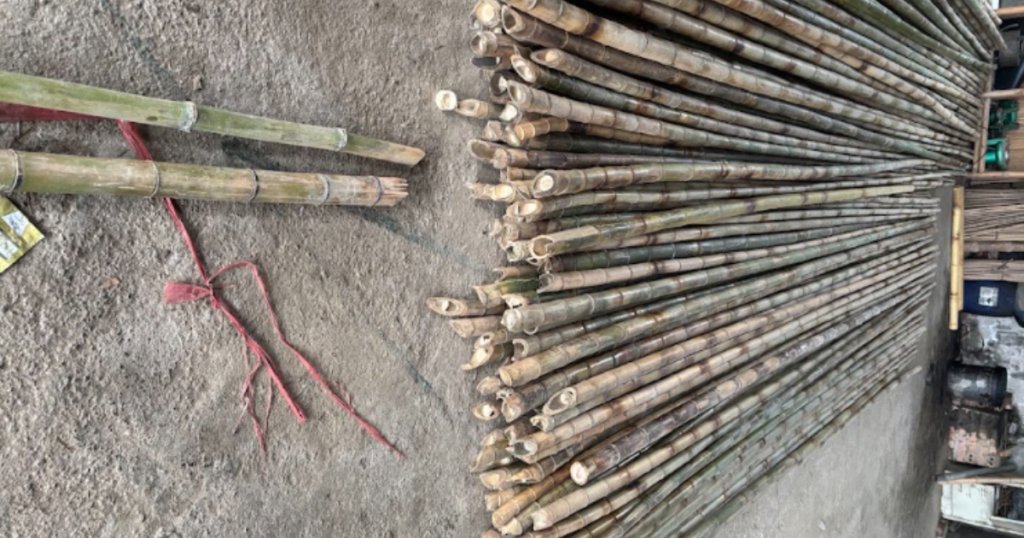
Typical bamboo compressive strength values by species and condition
The values below are the ranges published in ISO based test literature and in peer reviewed reviews of structural bamboo. They are a planning reference, not a substitute for a test report on the actual lot. Any project above a small pavilion should specify testing on delivered material.
| Species | Moisture condition | Compressive strength parallel to fibre | Notes |
|---|---|---|---|
| Dendrocalamus asper | Green, above 40 percent | 26 to 42 MPa | Thick walls, common for columns |
| Dendrocalamus asper | Air dry, 12 to 15 percent | 45 to 70 MPa | Drying raises the value substantially |
| Bambusa blumeana | Air dry, 12 to 15 percent | 40 to 62 MPa | Smaller diameter, dense outer wall |
| Phyllostachys pubescens | Air dry, 12 to 15 percent | 50 to 78 MPa | Moso, thinner wall, high fibre density |
| Mixed ungraded lot | Unrecorded | Not usable for design | Characteristic value collapses to the weakest specimen |
Read the second row against the first. The same species tested green and tested dry differs by roughly 60 percent. This is why bamboo compressive strength is always quoted with a moisture figure attached, and why a lot delivered wet cannot be assessed against a dry design value.
Why does moisture content move bamboo compressive strength so much?
Water sits in two places inside a culm: free water in the cell cavities, and bound water inside the cell walls. Free water leaving the cavity changes almost nothing. Bound water leaving the cell wall stiffens the wall itself, and that is what raises bamboo compressive strength as a pole dries below the fibre saturation point, which sits near 20 to 25 percent for most construction species.
Below that point, roughly every 1 percent drop in moisture adds around 3 to 5 percent to the compressive value until the culm reaches equilibrium with its environment. The gain is not permanent in the sense a buyer might hope. A dried pole installed in a humid coastal site will reabsorb moisture and give part of it back.
The practical consequence sits in the specification. Write the maximum moisture content at delivery, not just the target bamboo compressive strength, because the second is unenforceable without the first. Fifteen percent is a workable ceiling for covered structures in most of Southeast Asia, and 18 percent for open air work.
How do nodes and culm position change the result?
Nodes are stiffer and denser than internodes but they interrupt the longitudinal fibres, so a specimen containing a node usually gives a slightly lower value in compression than a clean internode from the same pole. The difference is modest, typically 5 to 12 percent, and it matters most in short members where a node lands near a bearing point.
Position along the culm has a larger effect. Fibre density rises towards the top of the culm as the wall thins, so a top section can show higher bamboo compressive strength per unit area while carrying far less total load because its cross section is smaller. Confusing stress with capacity here is a common error in tender documents.
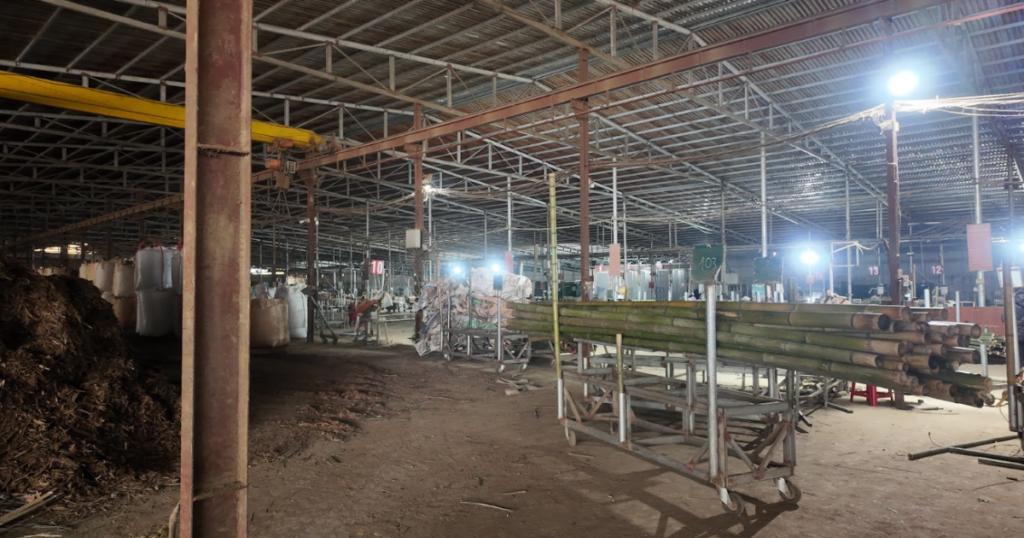
For column work the rule is straightforward. Use butt and mid sections for primary compression members, keep top sections for purlins and secondary framing, and make the sorting part of the grading step described in bamboo structural grading rather than leaving it to the site team.
From bamboo compressive strength to a design value
A test result is not a design value. ISO 22156 converts one into the other through a characteristic value, a material factor, and modification factors for duration of load, service moisture condition and, where relevant, temperature. Skipping that conversion is how a structure gets designed on a laboratory number and fails in the rain.
- Characteristic value: the fifth percentile of the test population, not the mean. A batch averaging 60 MPa may have a characteristic bamboo compressive strength near 45 MPa.
- Material factor: divides the characteristic value to account for natural variability and the limited size of most test samples.
- Duration of load factor: permanent load is treated more severely than short term wind load.
- Service condition factor: exposed or humid service reduces the value again.
The arithmetic is unglamorous but decisive. A published bamboo compressive strength of 60 MPa can land somewhere near 15 to 20 MPa as an allowable design stress once every factor is applied. Contractors who budget on the raw figure end up short of poles.
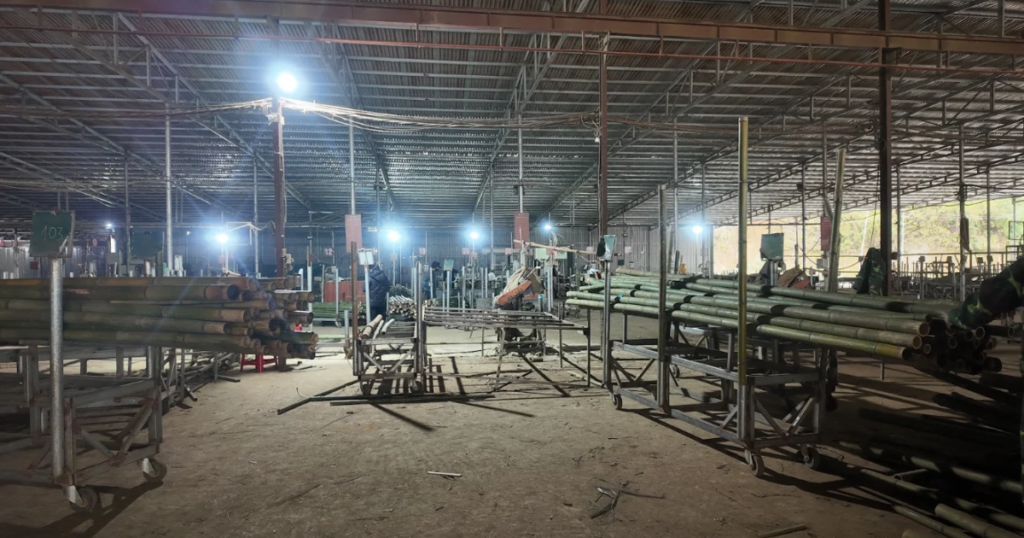
Why column capacity is not the same as bamboo compressive strength
A 100 mm pole with a 12 mm wall has a cross sectional area of roughly 3,300 square millimetres. Multiply by an allowable stress of 18 MPa and the crushing capacity looks like 59 kN. A 3 m column of the same pole will not reach that, because slenderness governs.
Bamboo is a hollow tube, which makes it efficient in buckling, but a 3 m unbraced length on a 100 mm section still gives a slenderness ratio that reduces capacity substantially. Bracing at mid height, or filling the node cavities with mortar at connection points, changes the answer more than choosing a species with higher bamboo compressive strength.
| Unbraced length | Pole 100 mm outside, 12 mm wall | Governing failure mode | Design note |
|---|---|---|---|
| Under 1.0 m | Near full crushing capacity | Material crushing | Short posts, jack studs, packing pieces |
| 1.5 to 2.5 m | Roughly 60 to 80 percent of crushing capacity | Inelastic buckling | Typical pavilion column with bracing |
| 3.0 to 4.0 m | Roughly 30 to 55 percent | Elastic buckling | Needs mid height bracing or a bundled column |
| Above 4.5 m | Below 30 percent | Elastic buckling | Use a bundle of three or four culms |
The table is indicative and no substitute for calculation, but it makes the point a specification needs to reflect. Ask for bamboo compressive strength data, then ask the engineer for the member capacity. Those two conversations produce different numbers and both belong in the submittal.
What test evidence should a project ask for?
Three documents cover the technical side of a bamboo compressive strength claim, and all three should be named in the purchase order rather than requested after delivery.
- Test report to ISO 22157 from an independent laboratory, stating species, number of specimens, moisture at test, and individual results rather than an average alone.
- Grading sheet for the delivered lot, so the tested population and the shipped population can be matched.
- Moisture log at packing, with the meter model and the number of readings, because the design value assumed a moisture condition.
Sample size matters more than most buyers realise. Six specimens produce a mean but a very weak characteristic value. Thirty specimens produce a characteristic bamboo compressive strength an engineer can actually use. Where a project is large enough to justify testing, specify the number of specimens in the contract.
What does bamboo compressive strength testing cost?
A thirty specimen compression series at an accredited laboratory in Vietnam costs roughly the same as two square metres of finished bamboo roof. Preparing the specimens, conditioning them to a stated moisture content and running the press takes about two weeks from the day the poles reach the laboratory.
Whether it is worth doing depends on what the structure does. A garden pergola on a private plot does not need a bamboo compressive strength report. A public pavilion, a restaurant canopy over seating, a two storey villa frame or anything requiring building control approval does, and the cost of the test is trivial against the cost of a redesign after the poles are already on site.
Group the testing where possible. One report covering a season of harvest from a single plantation serves several projects, provided the grading class and moisture condition match. Contractors running repeat work with the same supplier usually move to an annual test schedule rather than a per order one.
How is capacity checked on site before installation?
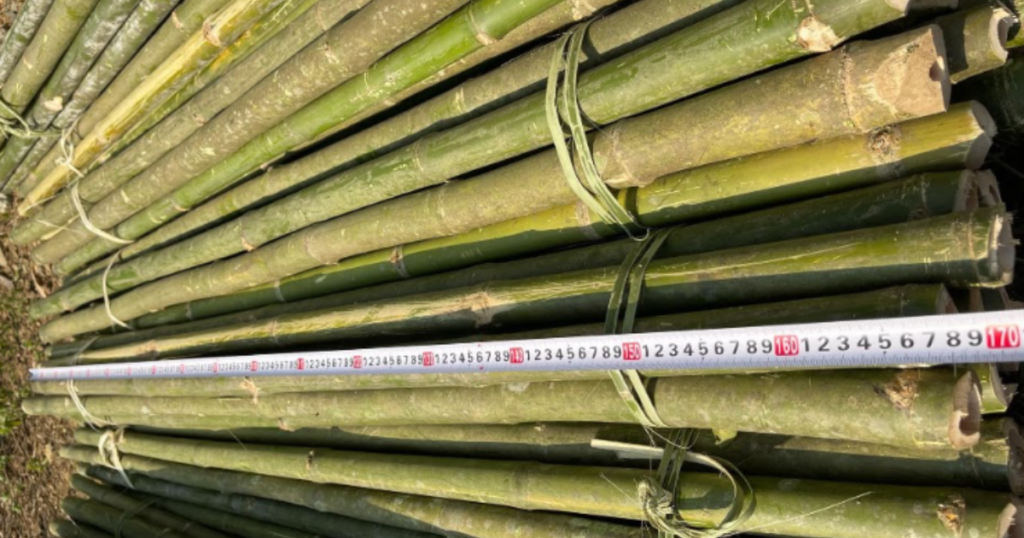
Site teams cannot run a compression press, but they can check the three inputs that the design value depended on. Wall thickness at the small end, moisture content with a pin meter, and the absence of through splits. If all three match the specification, the material behind the bamboo compressive strength assumption is the material that arrived.
A proof load test is the second option and it is more convincing than any certificate. Erect one column of the final design, load it to 1.5 times the design load with water drums or sandbags, hold for 24 hours and measure deflection. Contractors who do this once at the start of a project rarely argue about material afterwards.
Keep the evidence in one folder from day one: the grading sheet, the moisture readings taken at the gate, the photographs of the small end sections, and the proof load record with its deflection figures. Building control officers ask for exactly this set, and assembling it after the frame is up takes far longer than recording it as the material arrives. The folder also settles the question quickly if a pole is damaged during erection and a replacement lot has to be approved.
Frequently asked questions
Is bamboo compressive strength higher than concrete?
By stress, dry construction bamboo at 45 to 70 MPa sits above ordinary structural concrete at 25 to 40 MPa, and it does so at roughly one fifth of the density. By member capacity the comparison changes, because a concrete column has a far larger cross section. The useful comparison is strength to weight, where bamboo performs very well, not absolute load per member.
Does treatment reduce bamboo compressive strength?
Boron based preservation at normal concentrations has no meaningful effect on the mechanical properties. Heat treatment and carbonisation do reduce strength, typically by 5 to 15 percent depending on temperature and duration, because heat degrades some of the hemicellulose. If a project needs the darker carbonised appearance, tell the engineer, because the design value should be adjusted.
How old should a culm be for structural use?
Three to five years for most construction species. Below three years lignification is incomplete and bamboo compressive strength has not reached its plateau. Above six years the culm begins to lose toughness and becomes more prone to splitting during installation. Declared harvest age belongs on the grading sheet.
Can two suppliers quoting the same species give different strength?
Yes, and the gap can exceed 30 percent. Growing site, altitude, soil, harvest season and drying method all move the result. This is why test evidence is tied to a lot rather than to a species name, and why repeat projects with a fixed supply chain produce more predictable structures than spot buying does.
Conclusion
Treat bamboo compressive strength the way you would treat concrete cube results: as a measured property of a specific batch at a stated moisture content, not as a brochure figure. Specify the species, the maximum moisture at delivery, the test standard and the number of specimens, then let the engineer convert the characteristic value into an allowable stress with the factors ISO 22156 requires.
The detailing decides the rest. A pole with excellent material properties still fails at a badly made joint, so read how the load actually transfers in bamboo joint connections before finalising the column layout. Reference values used above follow the test framework published by the International Organization for Standardization, and construction grade culms are listed under bamboo poles.
Bamboo Supplier Vietnam supplies graded construction bamboo from two factories in Ninh Binh Province and Binh Duong Province, with grading sheets, moisture logs and independent test reports available per lot. Call or WhatsApp +84 338 286 268, or contact the project team with your species, grade and quantity.