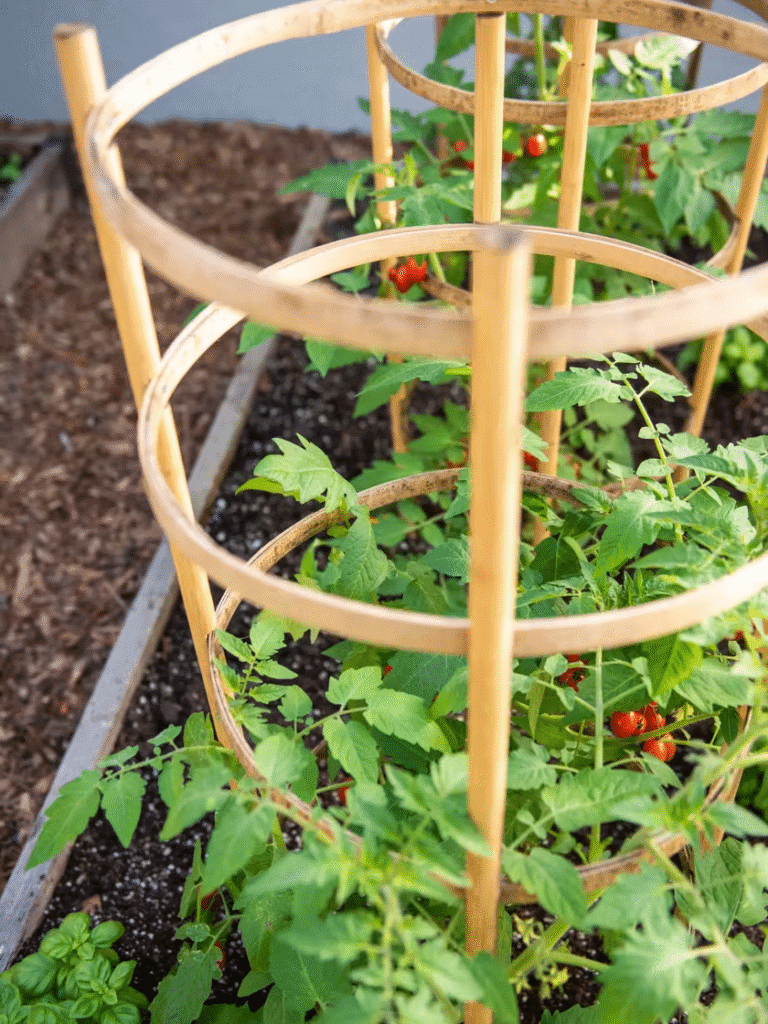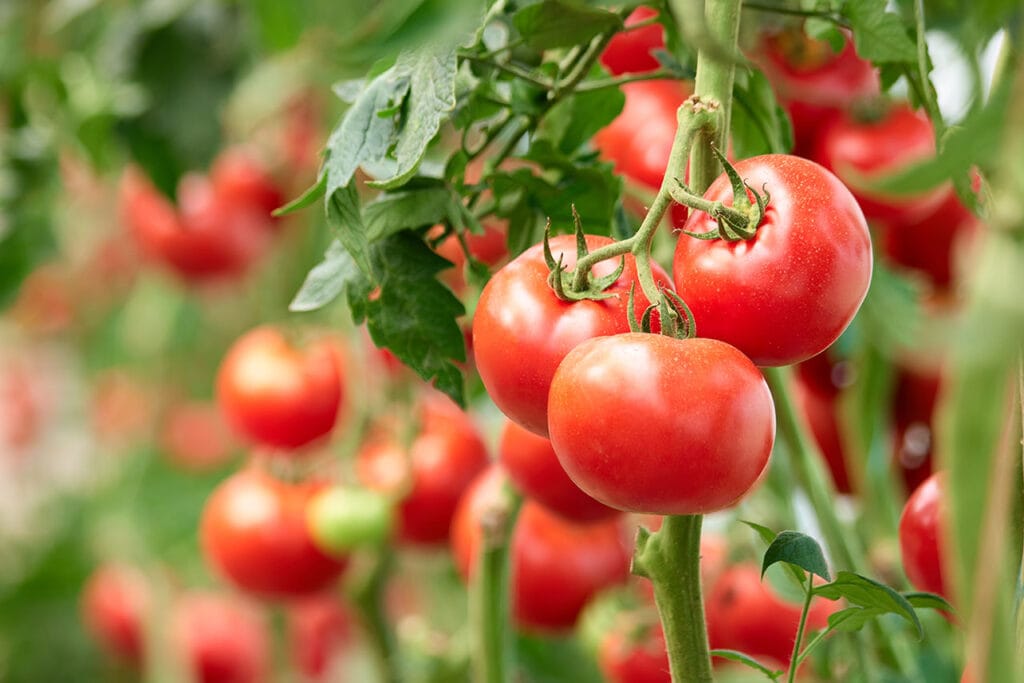
In the quiet geometry of a garden, few objects seem more inconspicuous than the tomato cage. It’s modest, skeletal, and often overlooked – a temporary scaffold meant to prop up vines heavy with fruit. Yet this minor structure carries a major signal. The material, the shape, and the way it’s placed all speak volumes about how a gardener views growth, control, and intervention in nature.
Some opt for industrial-grade steel cages: rigid, uniform, efficient. Others reach for more organic solutions like bamboo tomato cages: lighter, biodegradable, and visually in tune with the surrounding ecosystem. This isn’t just a matter of aesthetics or sustainability. It reveals a worldview, one that either insists on direction or allows room for natural negotiation.
In choosing between plastic ties and natural twine, between forced symmetry and flexible sway, the gardener isn’t just supporting a plant. They are projecting a belief: that living things thrive not just by being held, but by being understood.
To build a cage for a tomato plant, then, is not a neutral act. It is a quiet manifesto. And the question it raises is less about gardening than about design, care, and responsibility: When we build structures for life, are we shaping the plant or are we quietly shaping ourselves?
Form Reveals Philosophy: What Structure Says About Intention
In horticultural design, structure is rarely neutral. Every stake, line, or frame reflects not just functional utility, but the grower’s philosophy: consciously or not. The bamboo tomato cage, often viewed as a simple support device, is in fact a compelling artifact of belief: a physical embodiment of how we view growth, control, and trust.
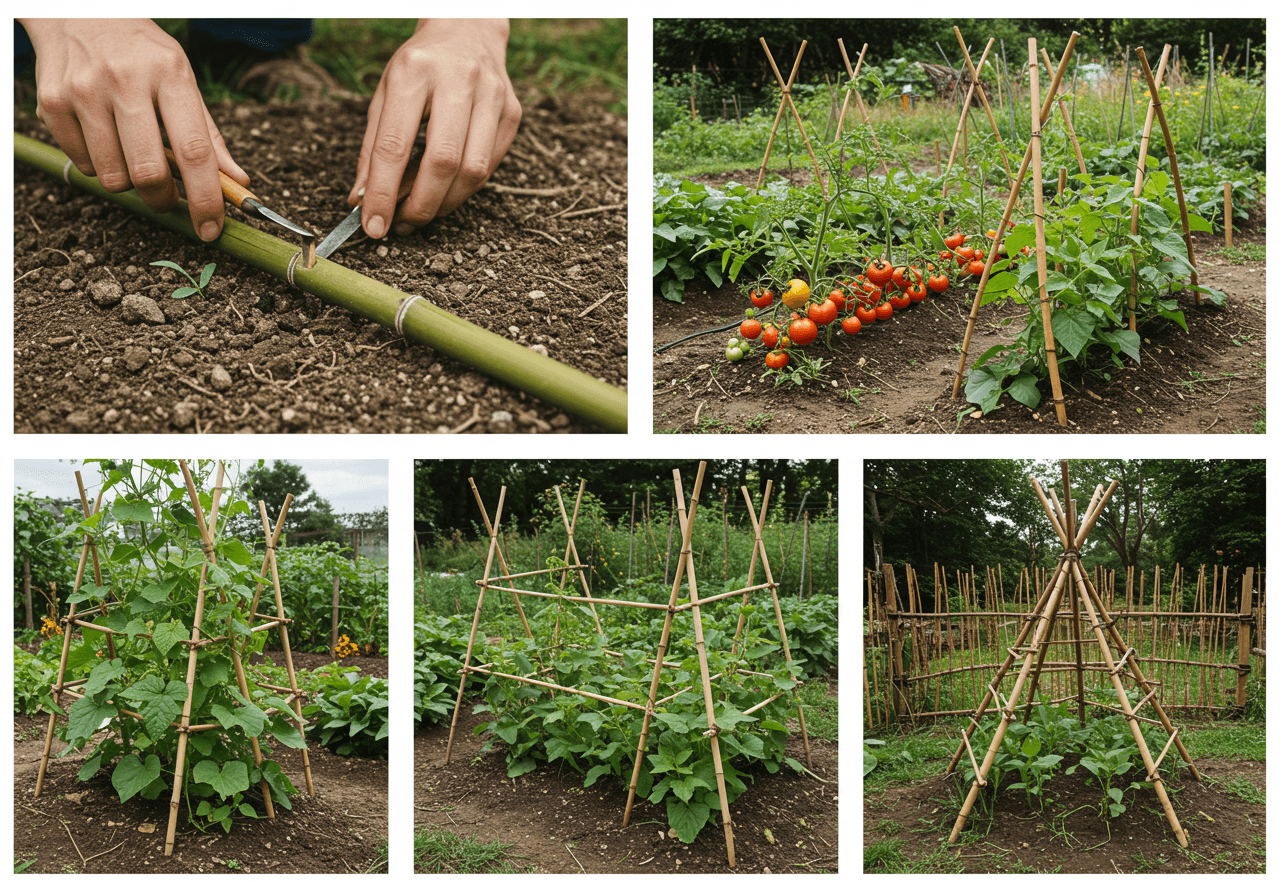
The Cage As A Statement Of Trust vs. Control
At its core, the design of a tomato cage reveals how much autonomy the gardener is willing to grant the plant. A fully enclosed bamboo frame, tightly bound, intersected with crossbars, signals a mindset centered on discipline and containment. The plant’s movement is guided, preemptively restrained to avoid unpredictability. This approach mirrors the philosophy of high-intervention agriculture, where outcomes are engineered through tight regulation.
Conversely, an open-frame bamboo tomato cage, perhaps minimal in verticals and devoid of cross-bracing, reflects trust. It leaves room for the vine to express its own logic of expansion. Here, the gardener functions more as a facilitator than a controller: providing initial orientation, then stepping back. This echoes the principles of low-intervention or regenerative systems, where plants are trusted to respond intelligently to their environment.
Height As A Proxy For Expectation
The vertical scale of the bamboo cage is also far from arbitrary. A low structure, suitable for determinate tomato varieties, implies modest expectations: the plant will grow to a defined limit, and support need only reflect that. A tall frame – extending well beyond the early height of the seedling – signals ambition. The gardener anticipates vigorous vertical growth and prepares for it in advance. This is not just a technical calculation; it is an act of projection, of placing faith in potential.
In behavioral design theory, this is a form of structural priming: the environment anticipates behavior and quietly nudges the subject (in this case, the plant) toward it. A higher cage, sturdily anchored, says: we believe this plant will rise and we will meet it there.
Geometry And The Nature Of Guidance
Beyond size and enclosure, the very angles and rigidity of the bamboo tomato cage communicate values. A straight, symmetrical frame aligns with formalist thinking: that growth should conform to an ideal shape: efficient, vertical, and replicable. This is order imposed upon nature. Alternatively, a slightly flexible, asymmetrical frame allows the plant to adapt organically to sunlight, airflow, or unexpected lean. It respects the vine’s natural agency.
This distinction mirrors debates in architectural philosophy and environmental psychology: do we design spaces to control behavior, or to respond to it? The tomato cage becomes a microcosm of that question, restated in bamboo and twine.
The Cage As Cartography Of Belief
In the end, the bamboo tomato cage functions as more than horticultural hardware: it is a quiet cartography of belief. Each joint, pole, and notch is shaped not just by botanical need but by human disposition. One grower ties every node tightly; another leaves joints to flex with the wind. One starts with a cage taller than the plant will ever need, while another adjusts as growth occurs. These differences may seem minor—but collectively, they form an ethic.
Are we builders of barriers or enablers of growth? Do we anticipate collapse or invest in resilience? In each bamboo frame, we can see the outlines of those answers.
The physical form of a bamboo tomato cage is not just about support. It is about intent. Whether we aim to direct, to adapt, or to trust, the structure we build around a plant reflects the structure we hold within ourselves. And that, more than any instruction manual, defines how the garden will grow.
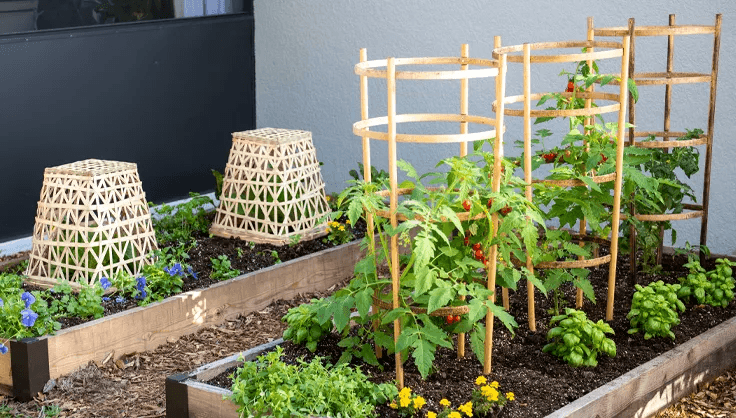
Bamboo As Quiet Support: Choosing Restraint Over Dominance
The materials we choose in the garden are not just technical solutions. They are reflections of our philosophy, of how we view control, nature, and the kind of support we believe growth requires. In this sense, the bamboo tomato cage becomes more than a horticultural tool. It becomes a quiet expression of belief: that care does not have to dominate, and that good support is often defined by its limits.
Bamboo, unlike metal or plastic, carries the unmistakable mark of impermanence. A typical bamboo tomato cage, exposed to sun, rain, and microbial activity in the soil, naturally degrades after one or two growing seasons. This inherent temporality signals a refusal to impose permanence on a process that is, by nature, seasonal. The gardener who chooses bamboo implicitly accepts that not all structures must last that support can be timely rather than eternal. In doing so, they embrace a view of gardening not as conquest over time, but as a participation in it.
Furthermore, bamboo does not assert itself as an industrial material would. While it offers sufficient structural strength for the upward and lateral needs of a maturing tomato plant, it does not impose rigidity. Its flexibility allows the plant to move, to respond to wind, to lean into the light. This kind of support mirrors a philosophy of care grounded in observation and adaptation, rather than preemptive control. According to the USDA Forest Products Laboratory, bamboo has one of the highest strength-to-weight ratios among natural materials, yet it performs best when its role is to assist rather than override. In this way, the bamboo tomato cage becomes a form of cooperative infrastructure, one that respects the plant’s own intelligence.
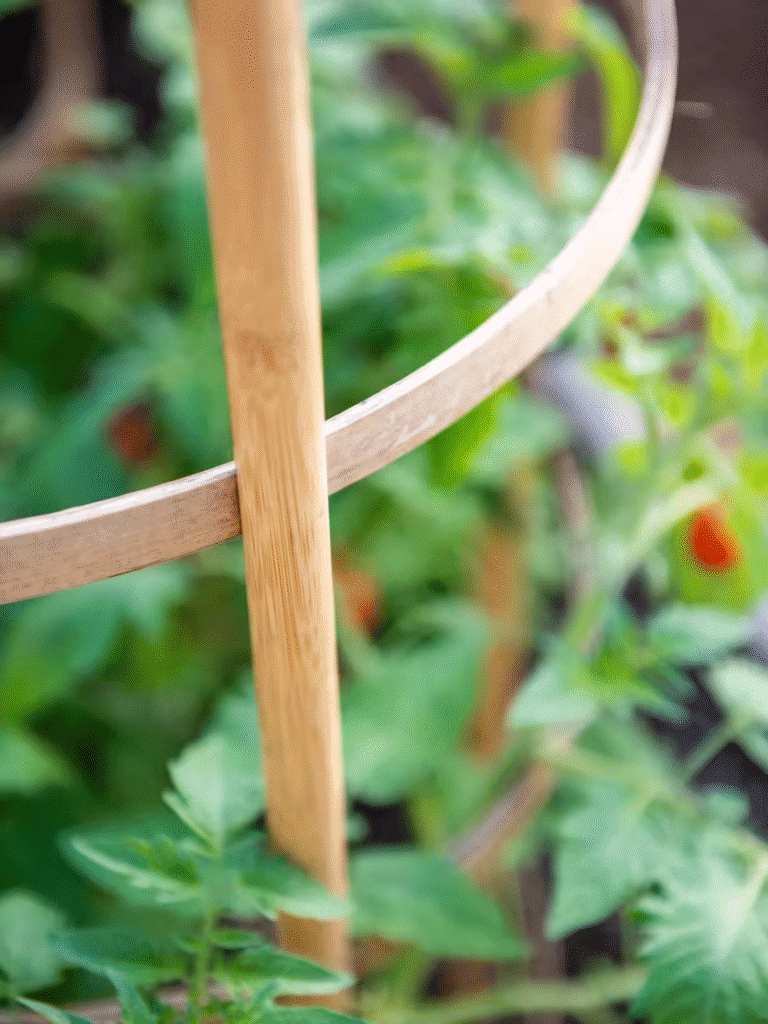
Its physical lightness also plays a symbolic role. A bamboo tomato cage can be set up, moved, or removed with minimal effort. This ease of reconfiguration speaks to a mindset that values flexibility over permanence. It allows the gardener to respond to the season’s shifts, to reframe their support as the plant’s behavior unfolds. In design theory, such adaptability is seen as a marker of resilience, not weakness. The structure yields so the system can persist.
What does this say about the gardener? It suggests someone who is willing to provide just enough and no more. Someone who understands that not all help requires control, and that growth, in both plants and people, benefits from space. The bamboo tomato cage, then, is not just a frame for the plant. It is a framework for a way of thinking: support should be present, but not permanent; reliable, but not rigid; responsive, but never restrictive.
Choosing bamboo is choosing restraint. It is the opposite of overdesign. It is the gardener saying, “I will hold you just enough for you to grow, then I’ll get out of the way.” And that choice, quiet as it may be, speaks volumes.
The Role Of Gaps: Why Not Every Space Must Be Filled
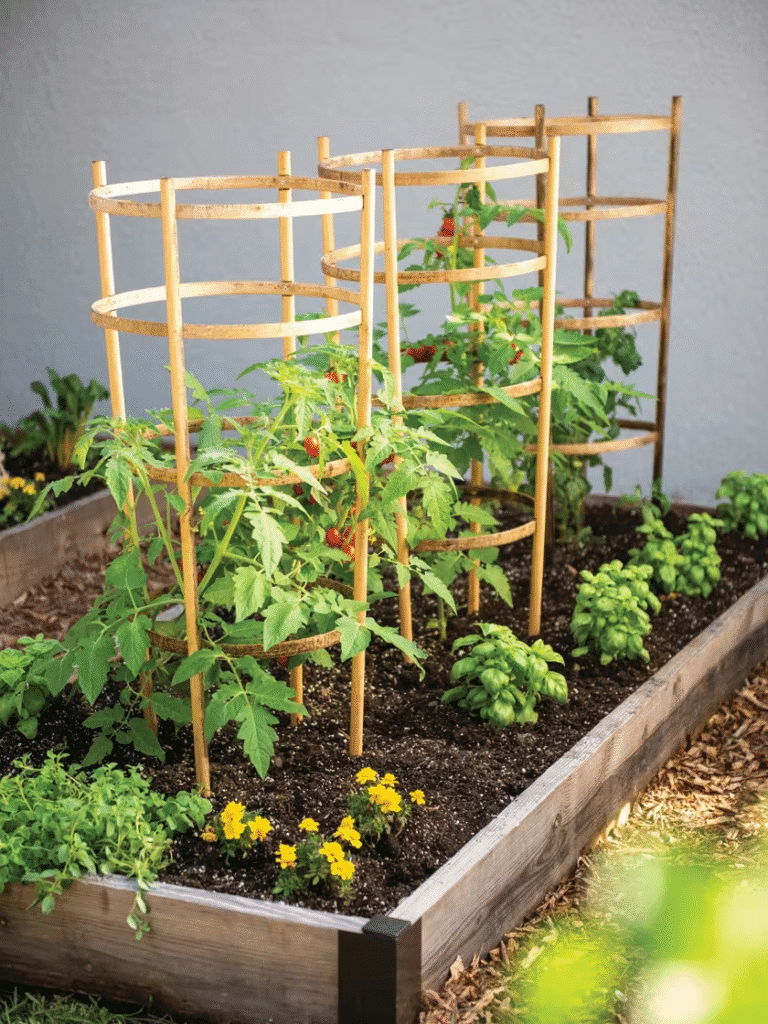
A tomato plant does not grow according to diagrams. It bends under fruit, leans into light, shifts in response to shade and wind. Its form is not stable but responsive, not static but intelligent. The structure that surrounds it must understand this. It must make room not only for what the plant is, but for what the plant might become. In this sense, the most important feature of a bamboo tomato cage is not its vertical poles or points of contact, but its deliberate openings. The frame offers orientation, but it is the empty space that makes adaptation possible. Growth does not need to be managed at every angle. It needs permission to find its own.
A closed metal cage offers another kind of logic. It holds every branch in place and defines every boundary in advance. It is designed for control, not negotiation. The assumption behind such a frame is that the ideal form can be preprogrammed, that deviation is disorder. But plants are not mechanical. When the frame refuses to flex, the stem must. And when that pressure exceeds the plant’s capacity to adapt, the result is injury. The tighter the structure, the more fragile the organism within it becomes. The same support that promises security becomes the very source of damage when the time comes to stretch beyond it.
The bamboo tomato cage holds a different view. It recognizes that what is left open is just as significant as what is held firm. It reflects a principle known across many disciplines but named with particular clarity in Japanese aesthetics. That principle is ma, the intentional space between things, the pause that allows breath, the silence that gives meaning to sound, the interval that shapes what surrounds it. In design, ma is not a void. It is a relationship. It is the awareness that presence and absence must exist together if either is to function fully.
Within a bamboo tomato cage, ma appears as the space through which the plant can move. These gaps are not blank. They are active participants in the process of growth. They give the plant something no rigid form can offer: a way to respond freely to the unpredictability of its own life.
To leave space is not to be absent. It is to be precise. The gardener who builds this kind of structure is not stepping away. They are choosing how to be present without becoming invasive. This is not neglect. It is discipline. It is the refusal to collapse care into control. A bamboo tomato cage is not an abdication of responsibility. It is a structure built on trust. It says to the plant: I am here to steady you, but I will not decide your shape. You will find that yourself.
And what does that say about the gardener?
Ultimately, how much space we allow reflects how much we trust. Gaps are gestures of faith, faith in the tree’s resilience, its intuition, its own design. When we choose not to control every inch, we are saying: “I believe you will find your shape.” And often, it is through these very openings, those accidental leanings, those imperfect bends that the most unforgettable forms are born.
In a world obsessed with precision and efficiency, the gap reminds us of the beauty of the unfixed, the value of the unfinished, and the strength of things that grow outside the lines.
Read more: Why Bamboo Stakes For Tomato Plants Are Perfect ?
Between Plant And Person: A Map Of Care
The bamboo tomato cage is not simply a structure for holding up a plant. It is a record of interaction, a slow choreography between the person who builds and the vine that grows. Every knot tied, every section left open, every angle adjusted over the course of a season reveals how the gardener sees their role in relation to the living thing they are tending. This structure is not passive. It registers presence. It reflects whether the gardener observes, whether they respond, whether they interfere too much or just enough. In that sense, the bamboo tomato cage becomes a quiet map of care, drawn not on paper but in space, gesture, and time.
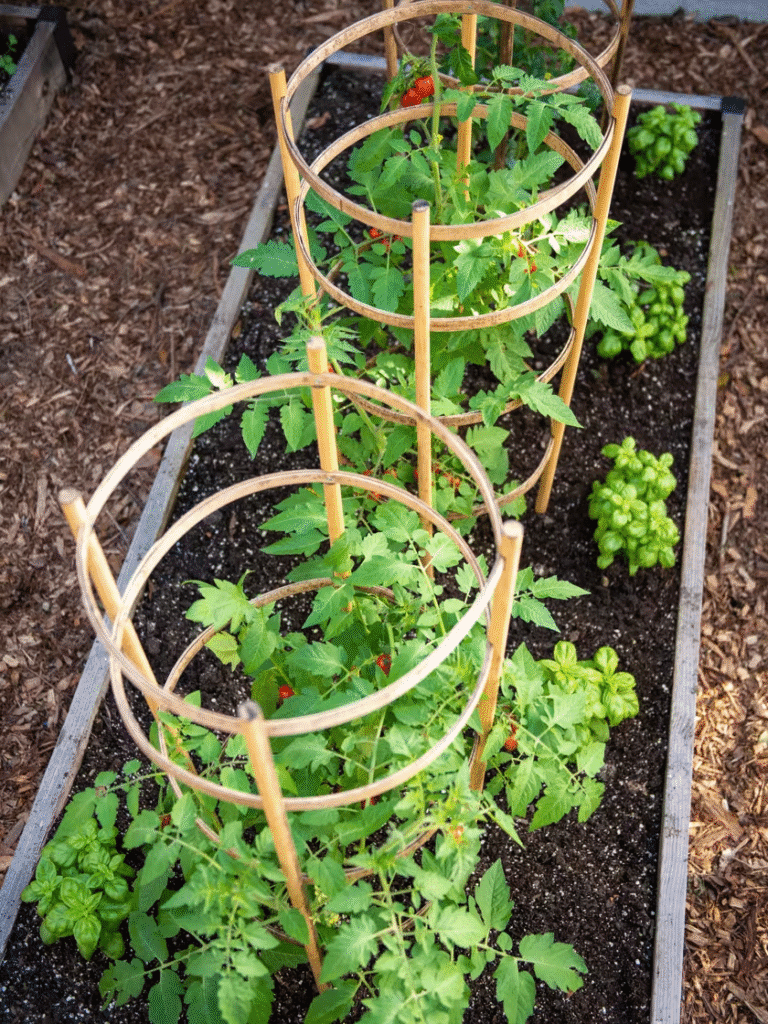
Unlike industrial metal frames, which impose uniformity and ask for nothing more after installation, the bamboo tomato cage requires the gardener to remain involved. Its material changes with weather and age. It bends, softens, loosens over time. It invites attention. And because no two tomato plants grow in exactly the same way, no two bamboo cages are shaped exactly the same. One plant may lean more heavily to one side. Another may split early into two stems. The frame, if made of bamboo, can be adapted. It allows for small shifts in structure to match the evolving shape of the plant itself.
There is a kind of intimacy in that ongoing adjustment. A willingness to change the frame not to force the plant into line but to meet it where it has naturally gone. That act, repeated over weeks and months, is not just a technical task. It is a philosophy. It says the gardener does not seek to impose order from above but to remain alongside, ready to respond. Choosing a bamboo tomato cage, then, is not only about aesthetics or sustainability. It is a choice that reflects a particular ethic of care, one that values softness over rigidity, flexibility over finality, and engagement over automation.
These frames may not be as symmetrical or durable as their metal counterparts, but they carry something else. They hold the signs of having been made by hand, for a specific plant, with a specific intention. The gardener who uses them accepts that support can be temporary, that it must bend with the needs of the moment, and that its value comes not from permanence but from presence.
What emerges from this is not a hierarchy between human and plant, but a shared rhythm. The gardener watches. The plant moves. The frame adjusts. The bamboo tomato cage becomes the medium through which that dialogue unfolds. It is not a cage in the restrictive sense. It is a space of translation. It allows the gardener to listen better and the plant to grow more freely. Between them is not a line of control, but a structure of understanding: fragile, flexible, and alive.
Conclusion
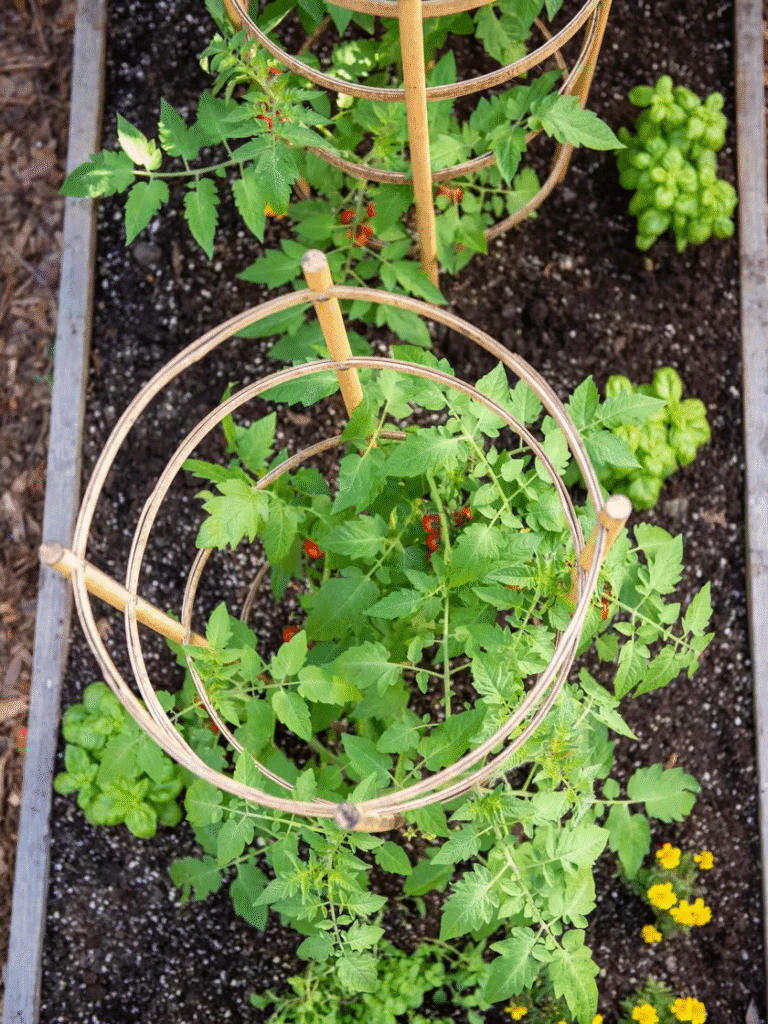
A bamboo tomato cage is more than a physical support. It is a quiet expression of how we choose to engage with life that grows. Its function is not simply to hold a plant upright, but to shape the way we think about care, control, and presence. When designed with intention, the bamboo tomato cage becomes a structural metaphor for a philosophy that values timing over pressure, responsiveness over rigidity, and trust over dominance.
Bamboo as a material offers exactly what this philosophy demands. It is strong enough to support, light enough to adapt, and soft enough to yield. It does not lock the plant into form but offers room for growth and deviation. The bamboo tomato cage welcomes variation, allows motion, and accepts that growth is not always symmetrical. Its openness is not a flaw but a decision. Its impermanence is not a weakness but a form of humility. Through its structure, it communicates a kind of care that is both gentle and exacting.
To use a bamboo tomato cage is to choose a different kind of relationship with the garden. One that involves attention rather than control, adjustment rather than enforcement. It means returning to the plant, not to fix it, but to observe what it needs and when. This way of working reflects a deeper worldview. It sees life not as something to be managed into perfection, but as something to be supported through change.
At Bamboo Supplier, we believe that every bamboo tomato cage we produce carries this mindset. Our products are not simply tools. They are thoughtfully crafted frameworks that reflect a living philosophy of care. Designed for adaptability, built for resilience, and chosen by growers who understand that true support is never rigid, each bamboo tomato cage we offer is a quiet commitment to sustainable growth.
Because in the end, the structure you choose to work with is never just about the plant. It is about how you choose to relate to growth itself. And through the form of a bamboo tomato cage, that choice becomes beautifully, unmistakably clear.